The Odyssey in Morocco: Filming Locations
Explore The Odyssey filming locations in Morocco, including Ait Ben Haddou as Troy, Essaouira’s Trojan Horse beach and the landscapes near Ouarzazate.
The Odyssey in Morocco
Christopher Nolan’s The Odyssey brings Homer’s ancient story of war, survival and homecoming to the cinema on an unusually large scale. Released on July 17, 2026, the film is also the first feature shot entirely with IMAX film cameras.
Although the story belongs to the ancient Greek world, several important parts of the film were created in Morocco. The country’s fortified villages, Atlantic beaches, mountain landscapes and established film-production infrastructure helped transform real Moroccan locations into Troy and other environments connected to Odysseus’s journey.
Ait Ben Haddou, near Ouarzazate, became one of the film’s most important Moroccan settings. Essaouira’s Atlantic coastline was used for major scenes involving the Trojan Horse, while the wider production also worked around Marrakech, Tahanaoute, El Haouz and Ouarzazate.
For travelers, this connection offers more than an opportunity to recognize places from a film. These locations are historic and culturally important destinations that existed long before the cameras arrived.
What Is The Odyssey About?
The Odyssey is based on the ancient epic traditionally attributed to Homer. It follows Odysseus, king of Ithaca, as he attempts to return home after the Trojan War.
His journey becomes a long struggle against storms, supernatural forces, dangerous creatures and the consequences of his own decisions. At home, his wife Penelope and son Telemachus continue to wait for him while facing growing pressure from men who believe Odysseus will never return.
The story is therefore not only an adventure. It is also about endurance, loyalty, identity, temptation and the meaning of home.
Christopher Nolan’s adaptation places particular importance on the physical experience of the journey. Instead of depending entirely on digital environments, the production traveled to real coastlines, caves, islands, deserts and historic landscapes.
That approach explains why Morocco became such an important part of the film’s visual world.
Why Morocco Was Chosen for The Odyssey
Morocco offers an unusual combination of landscapes within a relatively accessible area.
A production working from Marrakech can reach the High Atlas Mountains, dry valleys, fortified villages, open desert environments and the Atlantic coast. The country also has a long history of supporting international films through experienced local crews, production services, studios and large-scale locations.
For The Odyssey, Morocco provided three qualities that were especially useful.
First, the traditional earthen architecture around Ouarzazate could represent an ancient fortified city.
Second, the Atlantic beaches near Essaouira offered the open horizon and wide shoreline needed for the Trojan Horse sequence.
Third, the natural light, mountains and dry landscapes helped create a world that felt physical rather than digitally constructed.
Morocco was not simply used as an anonymous desert background. Its architecture and geography became part of the film’s representation of the ancient Mediterranean world.
Ait Ben Haddou as the City of Troy
Ait Ben Haddou is one of the most recognizable historic sites in southern Morocco. Located in Ouarzazate Province, it is a fortified village, or ksar, made from closely grouped earthen buildings surrounded by defensive walls and towers.
UNESCO describes it as an important example of the traditional earthen architecture of southern Morocco. The site also once stood along a commercial route connecting the Sahara with Marrakech through the Drâa Valley and surrounding mountain passes.
For The Odyssey, Ait Ben Haddou provided the architectural foundation for Troy.
Its reddish-brown walls, narrow passages and elevated towers already suggest the shape of an ancient city. The production expanded this environment with additional practical structures and sets, allowing the existing ksar and the surrounding valley to become part of a much larger cinematic Troy.
This use of Ait Ben Haddou demonstrates why the location remains so attractive to filmmakers. It has a strong visual identity, but it can also represent different historic periods without losing its connection to the surrounding landscape.
The Difference Between the Real Ksar and the Film Set
Visitors should understand that Ait Ben Haddou is not simply a permanent film set.
The historic ksar is a protected cultural site containing traditional homes, communal spaces, defensive structures and religious buildings. Some residents continue to maintain a connection with the village and the surrounding community.
Film productions may construct temporary walls, gates, streets or decorative elements beside the original buildings. These additions are often removed or altered after filming finishes.
Travelers should therefore visit Ait Ben Haddou for its architecture, history and landscape rather than expecting to find every structure shown in The Odyssey.
The film may introduce new audiences to the location, but the cultural importance of the ksar is much older and deeper than its appearance in international cinema.
Can You Visit Ait Ben Haddou?
Yes. Visitors can walk through the lower passages of the ksar and continue toward elevated areas overlooking the Ounila Valley.
The route includes uneven paths, steps and sloped sections. Comfortable shoes are recommended, particularly for travelers who plan to climb toward the upper viewpoints.
A local guide is optional but can provide useful information about the architecture, trading routes, residents and films connected with the site.
Ait Ben Haddou is often included in a full-day trip from Marrakech together with Ouarzazate. The journey crosses the High Atlas Mountains and is long, so an early departure is normally necessary.
Travelers with more time may prefer to stay overnight near Ait Ben Haddou or Ouarzazate. This provides more time to explore the ksar without rushing and makes it easier to experience the area early in the morning or near sunset.
Essaouira and the Trojan Horse
The Atlantic coast near Essaouira played another major role in The Odyssey.
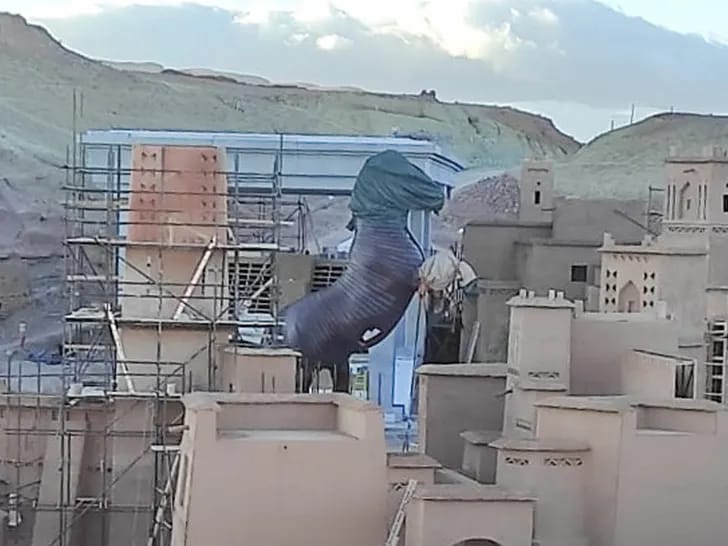
The production used the wide shoreline for scenes involving the Trojan Horse and the departure of Odysseus and his men after the war. A full-scale practical horse was constructed and used on the beach rather than replacing the entire object with computer-generated imagery.
The coastal environment created a powerful contrast with Ait Ben Haddou.
Troy appears enclosed by walls, towers and dry earth. Essaouira provides open water, wind, sand and the sense that an uncertain journey is about to begin.
The Atlantic horizon helps communicate the scale of the voyage facing Odysseus. Once the warriors leave the beach, they are moving away from the known world and toward a journey they cannot predict.
Why Essaouira Worked for the Film
Essaouira has a distinctive relationship with the ocean.
The city is known for its historic medina, defensive ramparts, fishing port, strong coastal winds and broad beaches. Its white buildings and blue details create a very different atmosphere from the earthen settlements around Ouarzazate.
For the production, the surrounding coastline provided space for practical sets, large groups of performers and wide IMAX compositions.
For travelers, however, Essaouira offers much more than a filming location.
Visitors can walk through the medina, observe fishing boats in the port, explore the ramparts, eat fresh seafood and spend time beside the Atlantic. The city has a slower rhythm than Marrakech and is suitable for either a full-day excursion or a longer coastal stay.
Visiting Essaouira from Marrakech
Essaouira can be reached from Marrakech during a full-day trip.
The journey usually allows time for the medina, fishing port, ramparts and waterfront. Travelers interested in The Odyssey can also appreciate the surrounding coastal landscapes that contributed to the film’s visual identity.
However, it is important not to expect a permanent Trojan Horse on the beach. Large props and temporary production elements are normally removed after filming.
The lasting experience is the coastline itself: open sand, Atlantic light, wind and the historic city beside the ocean.
A private excursion offers more control over departure time and stops. Shared transport can be more economical, but it generally follows a fixed schedule.
Marrakech and the Wider Moroccan Production
The production of The Odyssey was not limited to Ait Ben Haddou and Essaouira.
Reporting on the Moroccan shoot also identified Marrakech, Tahanaoute, El Haouz and Ouarzazate among the areas connected with the production. These locations form an important geographic corridor between the city, the High Atlas Mountains and the pre-Saharan landscapes of southern Morocco.
Marrakech is especially useful as a production base because it provides accommodation, transport connections and access to several different environments.
The same is true for visitors.
From Marrakech, travelers can organize:
- a day trip to Ait Ben Haddou and Ouarzazate;
- a coastal excursion to Essaouira;
- a journey through the High Atlas Mountains;
- a visit to desert-like scenery closer to the city;
- a longer route toward the Drâa Valley or the Sahara.
This makes Marrakech a practical starting point for a Morocco itinerary inspired by the film.
Ouarzazate and Morocco’s Film Industry
Ouarzazate has been connected with international cinema for many years.
The city and its surroundings offer large open landscapes, kasbahs, mountain roads and studio facilities. Productions can create historic cities, desert camps and fictional kingdoms while still working close to experienced local crews and production infrastructure.
Ait Ben Haddou’s proximity to Ouarzazate strengthens this relationship. Filmmakers can work with a real historic landscape while also using nearby studios and technical services.
For travelers interested in cinema, Ouarzazate can therefore complement a visit to Ait Ben Haddou.
Depending on time and opening conditions, visitors may see film studios, exterior sets or locations connected to earlier international productions.
Nevertheless, Ouarzazate should not be viewed only through foreign films. It is also a living southern Moroccan city with its own communities, markets, architecture and regional identity.
Practical Effects and Real Locations
One of the defining elements of The Odyssey is its dependence on physical environments.
The film was shot entirely with IMAX film cameras, including a new generation of lighter equipment developed for the production.
Large practical sets, real ships, natural coastlines and built structures were used to give performers a physical world in which to work.
The Trojan Horse is an important example. Instead of existing only as a digital model, it was constructed as a large physical object and used during the Moroccan beach sequence.
This approach gives Morocco a meaningful role in the film.
The country’s locations were not merely photographed and replaced later. Their light, terrain, architecture and weather directly influenced the images captured by the cameras.
Morocco’s Long Relationship With International Cinema
The Odyssey joins a much longer history of international productions filmed in Morocco.
The country is often chosen for historical films because it offers traditional architecture, open landscapes and locations that can suggest different periods and regions.
However, Morocco’s value to cinema does not come only from its appearance.
Local technicians, builders, drivers, production teams, craftspeople and extras contribute to these projects. The presence of established production services allows large international films to work across several regions.
Film tourism can create additional interest in destinations such as Ait Ben Haddou and Ouarzazate. At the same time, tourism should respect the residents and heritage of these places.
A historic village should not become only a background for photographs. Visitors should remember that its buildings require conservation and that local communities remain connected to the site.
A Note About Dakhla and Western Sahara
Some scenes connected with the production were also reported to have been filmed around Dakhla in Western Sahara.
This decision attracted criticism from Sahrawi cultural and human-rights advocates because Western Sahara remains a disputed territory. Critics argued that filming there without acknowledging the political context risked presenting the location as uncontroversially Moroccan.
A responsible article should not treat this issue as a simple tourism detail.
Travelers researching the film should understand that the political status of Western Sahara is contested and that different communities describe the territory in very different ways.
This controversy does not remove Morocco’s importance to the production, but it is part of the wider story surrounding where and how the film was made.
How to Explore The Odyssey Locations From Marrakech
Travelers who want to connect the film with a real Morocco itinerary can divide the experience into two main excursions.
Ait Ben Haddou and Ouarzazate
This journey crosses the High Atlas Mountains and continues toward the pre-Saharan landscapes of southern Morocco.
The main visit is Ait Ben Haddou, where travelers can explore the ksar associated with the film’s representation of Troy.
Ouarzazate can then provide additional context about Morocco’s film industry.
Because the driving distance is considerable, this excursion normally requires a full day. An overnight journey is more comfortable for travelers who want additional time.
Essaouira
Essaouira offers the coastal side of the film’s Moroccan story.
Visitors can explore the medina, port, ramparts and Atlantic beach environment connected with the Trojan Horse sequence.
The city can be visited in one day from Marrakech, although spending one or two nights creates a more relaxed experience.
Marrakech
Marrakech acts as the connection between these locations.
It provides the most practical base for arranging transport in two different directions: east through the High Atlas toward Ait Ben Haddou, and west toward Essaouira and the Atlantic coast.
Advice for Visiting Film Locations Respectfully
Do not climb on fragile walls or restricted structures.
Ask permission before photographing local residents.
Use authorized guides when you want detailed historical information.
Do not assume that every local person is involved with the film industry.
Support local restaurants, guides, accommodation and craftspeople.
Avoid presenting protected heritage as nothing more than a movie set.
Check current road, weather and opening conditions before traveling.
Use your own photographs or properly licensed images when publishing online.
Frequently Asked Questions
Was The Odyssey filmed in Morocco?
Yes. Several important parts of Christopher Nolan’s The Odyssey were filmed in Morocco, including scenes associated with Troy and the Trojan Horse.
Which Moroccan location represented Troy?
Ait Ben Haddou, near Ouarzazate, provided the principal Moroccan setting used to represent the ancient city of Troy.
Where was the Trojan Horse scene filmed?
The major beach sequence involving the Trojan Horse was filmed on the Atlantic coast near Essaouira.
Can travelers visit Ait Ben Haddou?
Yes. Ait Ben Haddou is accessible to visitors and can be explored independently or with a local guide. It is also a UNESCO World Heritage Site recognized for its earthen architecture.
Can I see the film sets?
Temporary production structures may already have been removed. Visitors can still experience the real historic architecture and landscapes used during filming.
Is Ait Ben Haddou close to Marrakech?
It can be visited from Marrakech during a long full-day journey across the High Atlas Mountains. Many travelers combine it with Ouarzazate.
Can Essaouira be visited in one day?
Yes. Essaouira is commonly visited as a full-day excursion from Marrakech, although staying overnight provides more time to experience the city.
Was the entire film made in Morocco?
No. Morocco was one of several countries used to create the different islands, kingdoms, coastlines and supernatural environments of Odysseus’s journey.
Was The Odyssey really filmed with IMAX cameras?
Yes. Official Universal and IMAX information describes it as the first feature film shot entirely with IMAX film cameras.
Why is Morocco popular with international filmmakers?
Morocco combines diverse landscapes, traditional architecture, experienced production crews and established support for foreign productions.
Final Thoughts
Morocco’s role in The Odyssey is one of the clearest examples of how a real place can help construct a legendary world.
Ait Ben Haddou gave the film an architectural foundation for Troy. Essaouira provided the Atlantic space required for the Trojan Horse and the beginning of Odysseus’s voyage. Marrakech, Ouarzazate and the surrounding regions supported the broader production.
Yet these destinations should not be valued only because they appeared in a film.
Ait Ben Haddou is an important example of southern Moroccan earthen architecture. Essaouira is a historic Atlantic city with its own artistic and maritime identity. Ouarzazate represents both Morocco’s film industry and the culture of the country’s southern regions.
The best way to experience The Odyssey in Morocco is therefore not simply to search for camera angles. It is to understand the places, histories and communities that allowed the cinematic world to exist.
Related topics